
Breathing Techniques to Calm Nerves and Speak Clearly During a Presentation

Your voice can feel steady in practice, then vanish the moment all eyes turn toward you. The throat tightens. The chest gets small. Words come out faster than planned. That reaction is common, and it is not a sign that you are unprepared.
Breathing is one of the quickest ways to regain control because it affects both your body and your speech. A slower breath can lower the intensity of nerves, while a better-timed breath can make your words sound clearer, warmer, and easier to follow.
This guide covers practical breathing techniques for a presentation, including what to do before you speak, how to breathe during your opening lines, and how to recover if nerves spike halfway through.
This is general information, not medical advice. If breathing exercises make you dizzy, uncomfortable, or short of breath, stop and return to normal breathing.
Audio

Why breathing changes the way you sound
Nerves often change breathing before they change words. When stress rises, many people breathe high in the chest, hold the breath, or take quick shallow inhales. That can create a chain reaction:
The voice sounds thinner or tighter.
Sentences run too long without enough air.
Speaking speed increases.
The mouth gets dry.
Pauses feel awkward, so the speaker fills them with “um” or “you know.”
Clear speaking needs air, but not a giant gulp of it. It needs steady, low, quiet breathing that supports each phrase. The goal is not to relax so much that you lose energy. The goal is to keep enough calm in the body that your message can come through.
Think of breathing as the base layer of delivery. Your slides, notes, and stories sit on top of it. If the base is shaky, everything else feels harder.
Start with a reset before you walk up
The best time to calm your breath is before the first word. Once a presentation begins, the brain has more to manage. A short reset beforehand gives your body a cue that it is safe enough to speak.
Use the three-breath arrival
This works well right before you stand, unmute, or step into view.
Put both feet flat on the floor.
Let your shoulders drop without forcing them down.
Inhale through the nose if comfortable.
Exhale slowly through the mouth.
Repeat for three full breaths.
On each exhale, let the jaw loosen. Many people carry presentation nerves in the jaw, tongue, and throat. Releasing those areas can make the first sentence sound less squeezed.
A good cue is:
“Feet down. Jaw soft. Breath low.”
That cue is short enough to remember when adrenaline rises.
Try the physiological sigh when nerves spike
A physiological sigh is a quick reset made of two inhales followed by a long exhale. It can feel especially useful when anxiety arrives suddenly.
Here is the pattern:
Take a medium inhale through the nose.
Before exhaling, take a small second inhale to top it off.
Exhale slowly through the mouth.
Do this once or twice. Avoid repeating it many times, since too much breathing control can make some people lightheaded.
Use it when you feel a sudden rush of heat, shaky hands, or the urge to rush. It is discreet enough to do before speaking or while someone introduces you.
Build a breathing pattern that slows racing thoughts
When the mind races, counting the breath gives it a simple job. That can pull attention away from worry and back into the body.

Use box breathing for steady control
Box breathing uses four equal parts:
Inhale for a count of 4.
Hold for a count of 4.
Exhale for a count of 4.
Hold for a count of 4.
Repeat for 2 to 4 rounds.
This technique is useful when you have several minutes before your presentation. It gives structure to your breathing and can help reduce the feeling of mental chaos.
If a four-count hold feels tense, shorten it. Try a count of 3, or skip the holds and use a simple inhale-exhale pattern instead. The technique should feel grounding, not like a test.
Use the longer exhale when you need quick calm
A longer exhale is one of the simplest ways to settle the body. Try this:
Inhale for a count of 4.
Exhale for a count of 6.
Repeat for 5 rounds.
The inhale should feel easy. The exhale should feel smooth, not forced. If you run out of air before the count of 6, use a 3-count inhale and a 5-count exhale.
This is a strong choice right before your opening line because it reduces the urge to gasp or rush.
Use gentle belly and rib breathing
Many people hear “breathe from your belly” and push the stomach out dramatically. That can create more tension. A better approach is to breathe into the lower ribs and abdomen without forcing anything.
Try this:
Place one hand on the lower ribs.
Place the other hand on the upper chest.
Inhale quietly and feel the lower hand move slightly.
Keep the upper chest relaxed.
Exhale and let the ribs soften inward.
This trains the body to take in air without lifting the shoulders. It also supports a fuller voice because the breath comes from a more stable place.
Match your breath to your words
Calming down is only half the job. The other half is using breath in a way that helps speech sound clear.
A common mistake is taking a big breath, then trying to spend it across a long sentence. The voice fades near the end. The speaker speeds up. The audience has to work harder.
A better method is to breathe at natural phrase breaks.
Mark your breath points
Before a presentation, look at your opening minute and mark where you can breathe. Use a slash if you like:
“Thank you for being here. / Today I’ll walk through the main problem, / the options we considered, / and the recommendation.”
This does three helpful things:
It slows the pace.
It makes pauses feel planned.
It keeps the voice from running out of air.
You do not need to mark the whole talk. Mark the first 60 to 90 seconds. Once the opening is steady, the rest often becomes easier.
Speak on the exhale
Speech happens on exhaled air. If you inhale and then hold your breath before speaking, the throat can tighten. Instead, let the first word ride out on the exhale.
Try this simple practice:
Inhale gently.
Begin speaking as the exhale starts.
Stop at the end of the phrase.
Let the next inhale arrive naturally.
Use a short sentence:
“Today, I want to make this simple.”
Say it once while holding your breath for a split second before speaking. Then say it again while letting the words begin with the exhale. The second version often sounds easier and more natural.
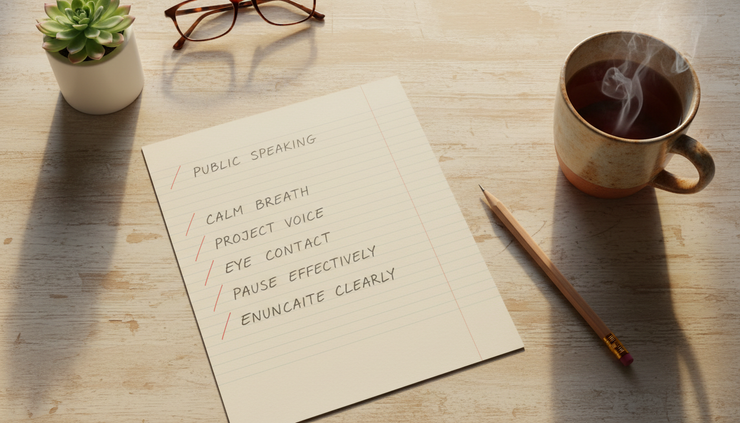
Pause before you need air
Many speakers pause only when they are empty. By then, the pause feels urgent. Instead, pause while you still have a little air left.
This gives you control. It also gives listeners time to absorb your point.
A useful rule is to pause:
After a key idea.
Before a number or important detail.
Between sections.
After asking a question.
When you feel yourself speeding up.
A pause that feels long to the speaker often feels normal to the audience.
Use breath to control a shaky voice
A shaky voice usually comes from a mix of adrenaline, muscle tension, and uneven airflow. You may not remove every tremor, and you do not need to. Most audiences notice less than you think. Still, a few breathing habits can make the voice feel steadier.
Hum before you speak
Gentle humming warms up the voice without drawing much attention. It also encourages steady exhalation.
Try this before your presentation:
Inhale gently through the nose.
Hum on a comfortable note for 4 to 6 seconds.
Feel a light buzz around the lips or nose.
Repeat 3 times.
Do not push volume. Keep it easy.
After humming, say your first line at a slightly slower pace than feels natural. Nerves tend to speed up speech, so a pace that feels a little slow may sound just right.
Use the straw breath for smoother airflow
If you have a straw nearby during practice, this can help you feel steady exhalation.
Inhale through the nose.
Exhale through the straw for 6 to 8 seconds.
Keep the airflow smooth.
Repeat 4 times.
Then remove the straw and speak a sentence with the same smooth outflow of air.
This exercise is best for practice, not necessarily for the moment right before you speak. It teaches the body what controlled airflow feels like.
Relax the tongue and lips
Breath and articulation work together. If the tongue is tight, words can feel trapped even when you have enough air.
Before speaking, try this quick release:
Press the tongue gently behind the lower front teeth.
Let the back of the tongue relax.
Blow air through loose lips once, like a soft lip trill.
Open the mouth and say, “Good morning” or your first line.
The goal is not to sound theatrical. It is to reduce the physical tension that makes speech feel harder.
Create a two-minute pre-presentation routine
A routine removes guesswork. Instead of wondering what to do with your nerves, you follow the same steps every time.
Here is a simple two-minute version:
Time | What to do | Why it helps |
30 seconds | Stand or sit with both feet grounded | Gives the body a stable base |
30 seconds | Breathe in for 4 and out for 6 | Slows the stress response |
20 seconds | Release jaw, tongue, and shoulders | Reduces vocal tension |
20 seconds | Hum gently three times | Warms up the voice |
20 seconds | Say your first sentence slowly | Builds familiarity |
20 seconds | Take one quiet breath and begin | Prevents a rushed start |
Practice this routine before low-pressure speaking too. Use it before a team update, a class discussion, a toast, or a recorded message. Repetition teaches your body that speaking starts with steadiness, not panic.
Recover during the presentation without anyone noticing
Even with preparation, nerves can return. You might lose your place, stumble over a phrase, or feel your heart pick up speed. The key is to recover without rushing to hide it.
Take a silent reset pause
Stop speaking at the end of a sentence. Look at your notes, your slide, or a friendly face. Take one quiet inhale and one longer exhale.
Then continue.
This feels obvious from the inside, but it often looks thoughtful from the outside. Speakers underestimate how acceptable a pause can be.
Sip water with purpose
A sip of water gives you a natural reason to stop and breathe. Use it after finishing a point, not mid-sentence if you can avoid it.
While you sip, relax your shoulders. Set the cup down. Exhale before you begin again.
Shorten the next sentence
After a stumble, do not restart with a long, complex sentence. Choose a short one.
Try:
“Let me say that more clearly.”
“The main point is this.”
“Here is the part that matters.”
“I’ll come back to the example.”
Short sentences help you regain rhythm. They also signal confidence because you are not flooding the moment with extra words.

Practice breathing with the actual presentation
Breathing exercises work best when they connect to the real task. If you only practice while sitting silently, the skill may disappear when you start speaking.
Use this practice plan:
Read your opening out loud once at normal speed.
Mark breath points where the phrasing feels natural.
Read it again, breathing only at those marks.
Record yourself on your phone.
Listen for rushed sections, fading volume, or swallowed endings.
Practice those sections with shorter phrases.
Pay special attention to the first sentence. A clear opening builds confidence fast. If your first sentence is long, split it into two.
For example:
Long version
“Today I’m going to explain why our current process is creating delays and what we can do over the next month to make it easier for everyone involved.”
Better version
“Today I’m going to explain why the current process is creating delays. Then I’ll show what we can do over the next month to make it easier.”
The second version gives you a clean breath point. It also gives listeners a clearer path.
Common breathing mistakes to avoid
Breathing techniques should make speaking easier. If they add pressure, simplify.
Watch for these common mistakes:
Taking huge breaths before every sentence
This can create tension in the chest and throat. Use quiet, medium breaths instead.
Holding the breath while thinking
If you lose your place, exhale first. Then look at your notes. Breath-holding makes panic feel stronger.
Practicing only in your head
Silent review does not train the voice. Speak out loud, even if softly.
Using a technique that feels unnatural
Box breathing, longer exhales, humming, and breath marking all help in different ways. Pick one or two that fit you. You do not need every technique.
Trying to erase all nerves
Some energy is useful. It can make your delivery more alive. Aim for steadiness, not total calm.
A simple plan for your next presentation
The next time you present, keep the plan simple.
Before you begin, take three slow breaths with a longer exhale. Relax your jaw. Hum once or twice if you have privacy. Look at your first sentence and mark one place to breathe.
When you start, speak on the exhale. Pause earlier than you think you need to. If your voice shakes, shorten the next sentence and let the breath settle before moving on.
Strong presentation breathing is a skill, not a personality trait. Practice it in small moments, and it becomes easier to access when the pressure rises. The goal is simple: breathe low, speak in phrases, pause with purpose, and let your message have room to land.


